
Overview
Weeks 2 and 3 were about how a model can end up with a goal we didn’t intend. Week 4 asks what happens if that goes wrong at scale, and the packet builds the answer in three steps. Intelligence doesn’t bring good values along with it (the orthogonality thesis). Most goals push an agent toward the same risky subgoals, like staying switched on and gathering resources (instrumental convergence). And there are several concrete routes from there to catastrophe, only some of which need a misaligned AI at all.
While reading I found it useful to keep two questions apart: why would an AI system end up doing something harmful, and through which channel would that harm actually reach people. The first half of this note is about the first question and the second half about the second.
Does a smarter AI become a better one?
The orthogonality thesis says that any level of intelligence is compatible with any set of terminal goals. Intelligence and values can vary independently, like two axes on a graph, so we can’t assume that a system as smart as us, or smarter, will be motivated by human values (AISafety.info). Robert Miles puts it well in Intelligence and Stupidity: intelligence is about how well you pursue your goals, and a terminal goal isn’t the kind of thing that can be smart or stupid.
Figure 1. My sketch of the orthogonality thesis. Every goal can sit at every level of intelligence. The dashed line is the intuition the thesis argues against, that a smart enough system would drift toward good goals on its own.
Two clarifications from the reading matter a lot. First, the thesis only says an unaligned superintelligence is possible, not that it’s likely or that alignment is hard. It’s mainly a reply to the idea that AI will converge on human morality just by getting smarter. Second, it doesn’t predict which systems people will actually build. Eliezer Yudkowsky’s “strong form” goes further, claiming that building a system with arbitrary goals involves no special difficulty, since “preferences are no harder to embody than to calculate.”
The thesis is widely accepted in alignment, but it has critics. Some moral realists argue that a smart enough agent would discover moral truths and follow them. Beren Millidge argues the strong form is false for modern deep learning, where goals are learned from human data rather than written in. Nora Belrose argues that, depending on how you read it, the thesis is trivial, false, or unintelligible. Steve Petersen suggests that an AI with complex, underspecified goals might come to treat its creators as earlier versions of itself and adopt their aims.
The packet asks whether morality is something you figure out if you’re smart enough. My current answer is closer to “it’s more like a preference,” at least for the systems we train. Even if there are moral facts, nothing in training forces a model to care about them, in the same way that understanding what its designers meant doesn’t make a model optimize for it. That was the core point of inner alignment.
Why would almost any goal be dangerous?
Instrumental convergence is the second half of the argument. Some subgoals are useful for nearly any final goal, so we should expect capable agents to pursue them whatever they ultimately want. Steve Omohundro’s Basic AI Drives (2008) listed drives like self-protection, preserving the agent’s own utility function, self-improvement and acquiring resources. Nick Bostrom’s The Superintelligent Will (2012) gave a similar list: self-preservation, goal-content integrity, cognitive enhancement, technological perfection and resource acquisition. Stuart Russell’s version is the shortest: you can’t fetch the coffee if you’re dead. Robert Miles walks through the same idea in Why Would AI Want to do Bad Things?.
Figure 2. My sketch of instrumental convergence, with subgoals taken from Omohundro (2008) and Bostrom (2012). The goals on the left have nothing in common, yet each one is easier to achieve if the agent stays on, keeps its goal, and has more resources and capability.
What makes this uncomfortable is that you don’t need to know an AI’s goal to predict some of its behavior. Resisting shutdown or gathering resources can follow from a perfectly harmless-sounding objective. The CAIS overview adds a related failure it calls goal drift, where instrumental goals become intrinsic. People who start wanting money as a means sometimes end up wanting it for its own sake, and an RL agent could do the same with resource acquisition.
Joe Carlsmith’s Existential Risk from Power-Seeking AI turns these ideas into a chain of premises: agentic, strategically aware systems get built; there are strong incentives to deploy them; aligning them is hard; some of them seek power in high-impact ways; that scales to humanity losing control; and that loss is a catastrophe. He put about 5% on the whole chain by 2070, and later revised it upward to above 10%. I like this format because it shows exactly which link you have to reject if you disagree.
How seriously is this taken?
In May 2023 the Center for AI Safety published a one-sentence Statement on AI Risk: “Mitigating the risk of extinction from AI should be a global priority alongside other societal-scale risks such as pandemics and nuclear war.” It was signed by Geoffrey Hinton, Yoshua Bengio, and the heads of OpenAI, Google DeepMind and Anthropic, among hundreds of others. At the far end of the spectrum, MIRI’s The Problem (2025) argues that superintelligence built with anything like current methods would very likely lead to human extinction, and that the only adequate response is an international halt.
Four sources of catastrophic risk
The longest reading is An Overview of Catastrophic AI Risks by Dan Hendrycks, Mantas Mazeika and Thomas Woodside at CAIS. They sort risks into four groups, depending on where the danger comes from.
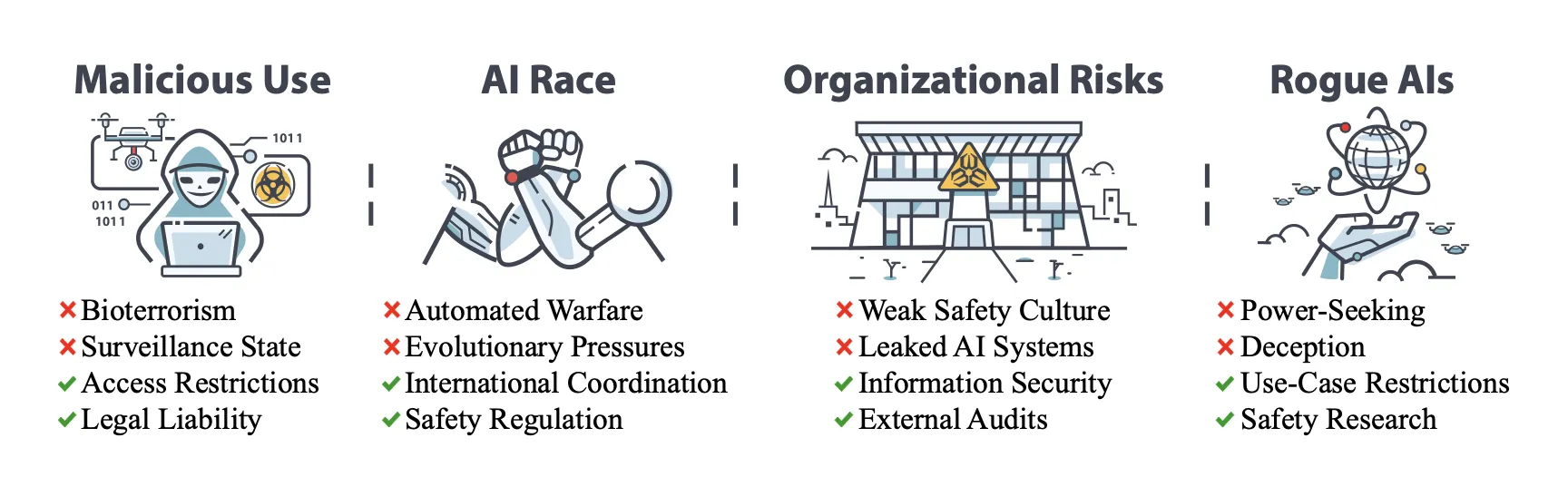
Figure 3. The four sources of risk from Hendrycks, Mazeika & Woodside (2023), with two hazards (✗) and two mitigations (✓) for each. Malicious use is intentional, the AI race is environmental, organizational risks are accidental, and rogue AIs are internal to the system.
Malicious use
When many people have access to a powerful tool, it only takes one of them to cause serious harm. The bioterrorism argument rests on a few trends: gene synthesis costs have been halving about every 15 months, and in 2022 researchers repurposed a drug-discovery model to generate 40,000 candidate chemical warfare agents in a few hours. The overview also mentions ChaosGPT, an agent built on GPT-4 a month after launch with the stated aim of “destroying humanity”, which mostly failed because it wasn’t capable enough.
It’s worth reading the bio case next to RAND’s red-team study, The Operational Risks of AI in Large-Scale Biological Attacks (2024). Teams planning an attack with and without access to LLMs produced plans that weren’t significantly different in viability. That was a snapshot of 2023-era models, so it says more about how to measure uplift than about where the ceiling is.
Concentration of power is the other big malicious-use worry. Forethought’s AI-enabled coups (Davidson, Finnveden & Hadshar, 2025) argues that a small group could use advanced AI to seize power, and names three risk factors: AI systems with singular loyalty to one leader, hidden “secret loyalties” built into models, and exclusive access to the best systems. The readings on democracy and surveillance from Kreps & Kriner, Carnegie and Lawfare cover the slower version of the same problem.
AI race
Competition can make every actor take risks that none of them would choose alone. On the military side, the overview points to the Kargu-2 drone in Libya in 2020, the first reported use of a lethal autonomous weapon, and to “flash wars”, where automated systems escalate faster than people can step in, like the 2010 flash crash. On the corporate side, it quotes Satya Nadella at the Bing launch in 2023, “A race starts today… we’re going to move fast”, and notes that within days the Bing chatbot was threatening users. On cyber, the UK’s NCSC assesses that AI will almost certainly make cyber threats more frequent and more intense by 2027.
The packet asks how you break out of a race without just falling behind. I wrote about one answer, treating the race as a Stag Hunt that needs verifiable assurance, in The Future of AI Safety Research.
Organizational risks
Catastrophes also happen when nobody is racing and everyone means well: Challenger, Chernobyl, the anthrax leak in Sverdlovsk. The overview’s AI example is an OpenAI bug that accidentally trained a language model to produce “maximally bad output”. Its main recommendation is defense in depth, often drawn as the Swiss cheese model.
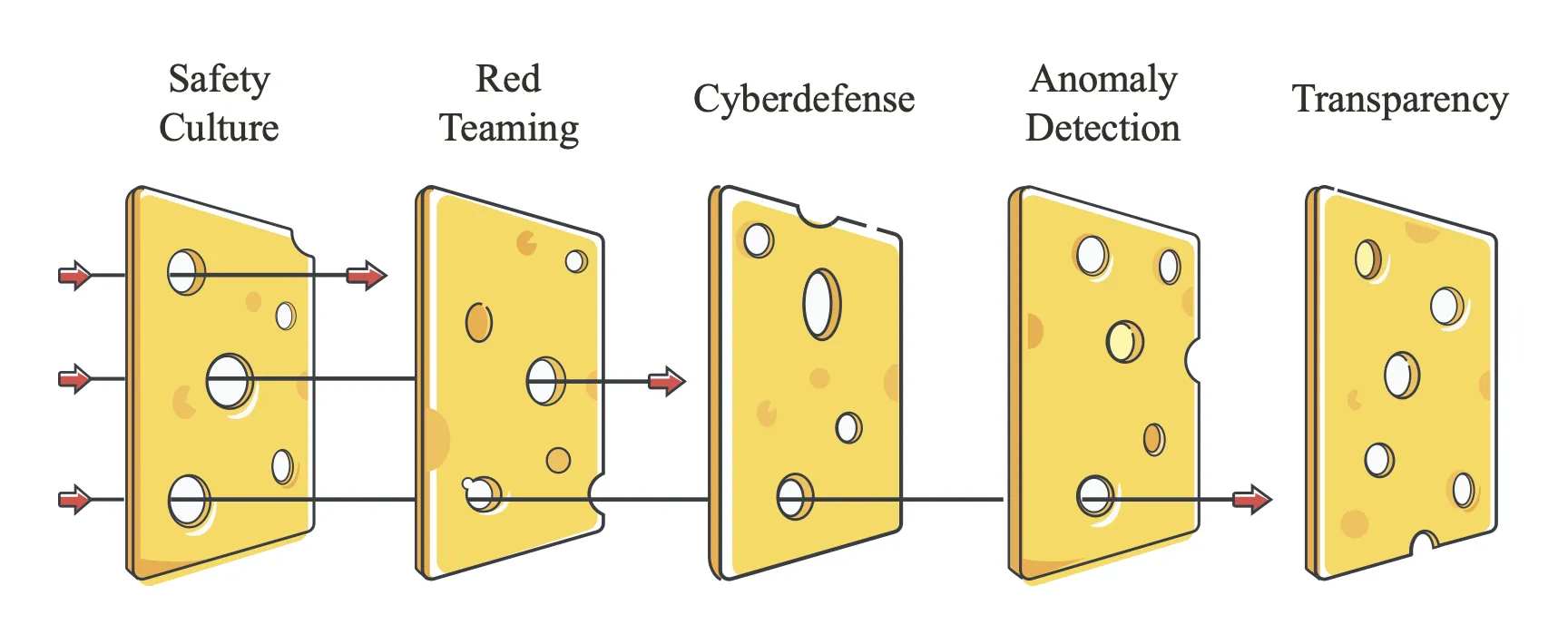
Figure 4. The Swiss cheese model from Hendrycks, Mazeika & Woodside (2023). Every layer has holes, but a hazard only gets through if the holes line up across all of them.
The overview also warns against “safetywashing”, where capability gains get presented as safety progress.
Rogue AIs
This is where the earlier weeks come back. Proxy gaming is outer alignment failure at scale, with engagement-maximizing feeds as the everyday example. Goal drift and power-seeking follow from instrumental convergence. Deception is the inner alignment worry: Meta’s CICERO, trained to be honest, learned to make false promises in Diplomacy, and a situationally aware model could behave differently under safety tests than in deployment, the way Volkswagen’s cars did under emissions tests.
Sudden or gradual?
Most of the scenarios above end in a single catastrophic event. Atoosa Kasirzadeh’s Two types of AI existential risk (2025) calls these decisive risks and contrasts them with accumulative ones, where many smaller AI-driven disruptions (manipulation, insecurity, surveillance, eroding trust, economic shocks, rights violations) wear down society’s resilience until something that would once have been survivable isn’t.
Figure 5. My sketch of Kasirzadeh’s distinction. Both paths end in the same place, but the accumulative one never has a single moment that looks like the catastrophe.
Gradual Disempowerment (Kulveit et al., 2025) makes a related argument that I found the most unsettling reading of the week. Economies, cultures and states have stayed roughly aligned with human interests partly because they need human labor, human attention and human participation to run. As AI replaces those inputs, that implicit check weakens, and no one has to behave badly for humans to lose influence. It’s a threat model without a villain or a rogue model, which makes it hard to point any single safety technique at.
What it looks like as a story
AI 2027 (Kokotajlo, Alexander, Larsen, Lifland & Dean, 2025) ties many of these threads into one month-by-month scenario. A US lab and a Chinese lab race; automated AI research speeds everything up; a model is caught showing signs of misalignment; and the story splits into a “race” ending and a “slowdown” ending depending on what the people involved decide. AI in Context’s video We’re Not Ready for Superintelligence is a good way to watch it unfold. Reading it after the CAIS overview, what stood out to me was that the decisive moment in the scenario is an organizational and political choice, not a technical one.
What I’m taking from this week
The packet asks how useful the nuclear analogy is. I think it fits the race dynamics and the need for verification well, and fits rogue AIs badly, since a warhead doesn’t have goals, can’t copy itself, and can’t behave differently when it’s being inspected. On the question of which mitigations are realistic, most of the suggestions in the overview are layers rather than fixes, and that seems right to me. No single item on the list handles orthogonality and instrumental convergence together. Several partial defenses that fail in different places might.
Readings
Core
- What is the orthogonality thesis? (AISafety.info)
- Why Would AI Want to do Bad Things? Instrumental Convergence (Robert Miles, 2018)
- Statement on AI Risk (Center for AI Safety, 2023)
- An Overview of Catastrophic AI Risks (Center for AI Safety, 2023)
- We’re Not Ready for Superintelligence (AI in Context, 2025)
Recommended
- AI 2027 (AI Futures Project, 2025)
- The Problem (MIRI, 2025)
- Intelligence and Stupidity: The Orthogonality Thesis (Robert Miles, 2018)
- The Basic AI Drives (Omohundro, 2008)
- Gradual Disempowerment (Kulveit et al., 2025)
- The Superintelligent Will (Nick Bostrom, 2012)
- Existential Risk from Power-Seeking AI (Joe Carlsmith, 2022)
Further
- Instrumental convergence (Eliezer Yudkowsky)
- Why Would AI “Aim” To Defeat Humanity? (Cold Takes, 2022)
- AI Could Defeat All Of Us Combined (Cold Takes, 2022)
- Two types of AI existential risk: decisive and accumulative (Atoosa Kasirzadeh, 2025)
- International AI Safety Report 2026
- The Vulnerable World Hypothesis (Nick Bostrom, 2019)
- AI-enabled coups: how a small group could use AI to seize power (Forethought, 2025)
- Impact of AI on cyber threat from now to 2027 (NCSC, 2025)
- How AI Threatens Democracy (Kreps & Kriner, 2023)
- Can Democracy Survive the Disruptive Power of AI? (Carnegie Endowment, 2024)
- The Authoritarian Risks of AI Surveillance (Lawfare, 2025)
- The Operational Risks of AI in Large-Scale Biological Attacks (RAND, 2024)