
Game theory gives us a compact vocabulary for thinking about cooperation. It helps explain why individually reasonable choices can produce collectively poor outcomes, why trust sometimes emerges among self-interested actors, and why a stable equilibrium may still be far from socially desirable.
For Cooperative AI, those distinctions matter. A multi-agent system may fail because agents cannot identify a common strategy, because defection pays, or because cooperation creates value without agreement on how to divide it. These are different failures, and they call for different responses.
I first encountered the stag hunt in an International Relations class while studying realism, security dilemmas, and the Thucydides Trap. The political framing made the core intuition vivid: two actors may both prefer cooperation, yet fear and uncertainty can make a safer, worse equilibrium look rational.
Much of the game theory I learned in political science focused on deterrence, bargaining, institutions, and international crises. Cooperative AI does not replace that tradition. It extends many of the same questions into computational settings populated by learning agents.
Games about cooperation and cooperative game theory
It helps to separate games about cooperation from cooperative game theory in the technical sense.
The stag hunt and prisoner’s dilemma are usually modeled as non-cooperative games. Each player chooses independently, and the analysis asks which outcomes are stable given the incentives of the other players. A Nash equilibrium is one such outcome: no player can improve their payoff through a unilateral change.
Cooperative game theory starts elsewhere. Instead of focusing only on isolated moves, it studies what groups of players can achieve by forming coalitions, and how the gains from cooperation should be allocated. If several AI agents solve a task more effectively together than apart, the coalition creates value, but that does not answer the distributional question of who deserves what share.
Ideas such as the core and the Shapley value help formalize those issues. The core asks whether an allocation is stable against breakaway coalitions. The Shapley value assigns each participant a share based on average marginal contribution. These tools may help with multi-agent task allocation, joint safety investments, or credit assignment, but they do not settle the normative question of fairness. A mathematically elegant solution is not automatically just, especially if the model excludes those affected by the coalition’s behavior.
Stag hunt: cooperation under uncertainty
The stag hunt describes a problem of assurance.
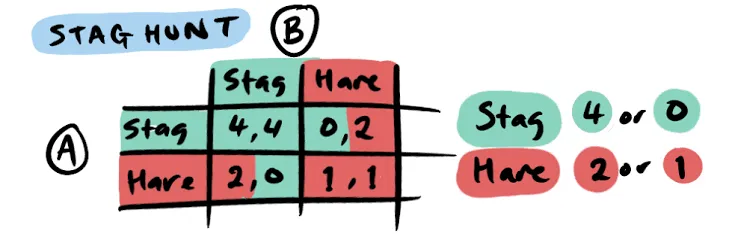
Source: Stag Hunt Game. Mutual stag is payoff-dominant, while mutual hare is the safer equilibrium.
Two hunters may cooperate to catch a stag, which offers a large reward, or hunt a hare alone, which gives a smaller but safer return. A stag can be caught only if both hunters commit.
This game has two Nash equilibria: both hunt stag, and both hunt hare. Yet they are not equally good. Mutual stag hunting is payoff-dominant, while mutual hare hunting is safer from the perspective of each individual player. The failure here is not mainly temptation to exploit. It is uncertainty about whether the other player will follow through.
That difference matters for intervention design. A prisoner’s-dilemma problem may require changing incentives. A stag-hunt problem may instead require communication, common knowledge, reputation, credible commitments, or shared conventions.
The same structure can appear in AI systems. Imagine two agents responsible for connected electricity networks. Each can maintain an expensive reserve, or they can coordinate forecasts and share spare capacity. Joint planning could lower costs for both, but relying on shared capacity becomes risky if either agent doubts that the other will provide support when demand spikes. More intelligence alone does not guarantee the better equilibrium. The systems may need verification, reliable communication, fallback procedures, and explicit commitments before cooperation becomes safe enough to adopt.
Pareto efficiency: improvement without agreement on fairness
A provocative definition from one fellowship discussion was that agents are cooperating if they are always, to the extent of their capabilities, allocating resources or utility in a Pareto-optimal fashion.
That captures something important, because cooperation should not leave obvious mutual gains unrealized. Still, Pareto optimality is too weak to serve as a full account of cooperation.
A Pareto improvement makes at least one participant better off without making anyone else worse off. One outcome Pareto dominates another when it is at least as good for every participant and strictly better for at least one. An outcome is Pareto efficient when no feasible Pareto improvement remains.
In the stag hunt, the high-payoff cooperative outcome Pareto dominates the safer low-payoff one. This shows why equilibrium and welfare must be kept separate. Stability tells us whether an outcome resists unilateral deviation. Pareto analysis asks whether a better feasible arrangement exists.
Pareto efficiency, however, says little about equality. An allocation in which one actor controls nearly everything may still be Pareto efficient if redistribution would make that actor worse off. For AI, the deeper limitation is that Pareto efficiency is always relative to a chosen set of agents, utilities, and feasible outcomes. An agreement may be Pareto-improving for two AI delegates while imposing costs on workers, consumers, smaller states, or future generations who never appeared in the model.
That leaves three distinct questions. Is the policy Pareto efficient for the modeled agents? Are those agents faithful representatives of the relevant stakeholders? Is the resulting distribution of power and welfare morally acceptable? Pareto efficiency answers only the first.
Prisoner’s dilemma: when defection pays
The prisoner’s dilemma captures a different problem. Here, each player has an individual incentive to defect regardless of what the other does. When both follow that logic, they reach an outcome that is worse for each of them than mutual cooperation would have been.
This pattern appears whenever local incentives undermine collective performance. Agents may hoard resources, free-ride on shared safety investments, withhold information, or optimize for short-term gain while worsening the overall system.
Consider AI agents acting for competing laboratories. Each lab may benefit collectively from careful safety testing and restrained deployment. Yet any one lab could gain a temporary advantage by moving earlier and letting others absorb more of the safety cost. If all labs reason this way, the result may be an arms race that none of them originally preferred.
Greater capability does not solve this dilemma. A more capable agent may simply defect more effectively. Stable cooperation instead depends on changing the structure of incentives through monitoring, repeated interaction, enforceable commitments, shared standards, or penalties that make opportunism less attractive.
The evolution of trust
Nicky Case’s interactive game The Evolution of Trust visualizes Robert Axelrod’s iterated prisoner’s dilemma experiment and turns it into a vivid explanation of how trust depends on the structure of interaction. Once the game repeats, the strategic landscape changes. Reciprocity can perform well because cooperative agents can build mutually beneficial relationships while also responding to exploitation.
Noise complicates the picture. A single mistaken defection between two strict reciprocators can trigger a long chain of retaliation. More forgiving strategies can therefore outperform exact retaliation when miscommunication is present. The broader lesson is institutional rather than psychological. Trust is not simply a personality trait. It emerges, or fails to emerge, because of the structure of the game.
That insight matters for AI design. An agent expected to cooperate repeatedly needs a persistent identity, some memory of prior interactions, and a reason to value future outcomes. It also needs mechanisms for distinguishing exploitation from error. Without repair protocols or calibrated forgiveness, small failures can escalate into durable conflict.
At the same time, trust should not become blind compliance. An agent that always cooperates is easy to exploit. Useful cooperation requires a balance between openness, responsiveness to genuine defection, and the ability to recover from plausible mistakes.
There is also a safety warning here. Conditions that help AI agents trust one another can support collusion just as easily as prosocial cooperation. The goal is not maximum trust among agents. It is well-governed, legible, and human-compatible cooperation.
From static games to learning agents
Classical game theory often starts with fixed players, known actions, and specified payoffs. Multi-agent learning makes all of that less stable.
Agents learn while they interact. Their policies change, their beliefs adapt, and their behavior alters the environment faced by others. What looked optimal yesterday may stop working once a partner adopts a new strategy.
Several difficulties follow. Credit assignment becomes hard when a shared reward does not reveal which agent contributed what. Non-stationarity arises because every learner is part of every other learner’s environment. Equilibrium selection matters when multiple stable joint policies exist. Partner generalization matters because a policy that works with familiar partners may fail badly with new ones.
Communication protocols, partner modeling, reward decomposition, contracts, and norm learning each address different parts of this landscape. There is no single mechanism called cooperation. There is instead a layered design problem involving incentives, information, learning dynamics, and institutions.
Why Cooperative AI focuses on mixed-motive settings
One thing that became clearer to me while reading A Review of Cooperation in Multi-agent Learning was why mixed-motive settings keep showing up at the center of Cooperative AI. The paper separates the space into team-based settings and mixed-motive ones, and that distinction helped me organize a lot of ideas that had previously felt blurred together in my head. In a fully cooperative setting, the problem is already hard enough. But in a mixed-motive setting, the difficulty feels more realistic to me, because agents can benefit from cooperation without fully sharing interests, and that feels much closer to politics, institutions, and the kinds of strategic environments I usually find most compelling.
I also just learned a lot from this paper in general. There are so many useful concepts packed into it, but the part I found especially helpful was the discussion of how cooperative policies are actually constructed across different learning setups, rather than treating “cooperation” as though it were one single thing you can just switch on. That helped me see more clearly that policy construction depends on architecture, information structure, training regime, and how agents are expected to coordinate under uncertainty. It made the whole field feel less like a vague moral aspiration and more like a set of concrete design problems.
I kept coming back to the question of credit assignment. That part interests me a lot because it feels like one of those problems that sounds technical at first, but actually reaches into the heart of cooperation: if a team succeeds, how does any agent learn what it specifically contributed to that success, and how do we stop joint reward from washing away meaningful differences in effort or causal importance? I have some thoughts on this mechanism already, especially because it seems like weak credit assignment can make cooperation look better on paper than it really is in practice.
What I am less clear on is evaluation. Do we actually have a benchmark for credit assignment itself, or are we still mostly inferring it from downstream performance on cooperative tasks? The review discusses evaluation metrics and common benchmarks, but my impression is that there is still no single agreed standard for saying that a credit assignment method is genuinely good in its own right, rather than just helpful on a few environments. So part of what I am now wondering is not only whether a mechanism works, but how good it should be, what exactly it should be measured against, and whether the field has a satisfying answer to that yet.
Advanced AI systems may act on behalf of different people, firms, laboratories, or governments. Even if each system is reasonably aligned with its own principal, the principals themselves will not share one objective. Their agents will bargain, withhold information, form coalitions, make commitments, and sometimes defect. That is part of why mixed-motive interaction feels so central to AI safety.
At the same time, I do not think adversarial settings become unimportant just because mixed-motive ones are rich. Conflict, exploitation, robustness, and escalation still matter. More capable agents may coordinate more effectively, but capability alone does not tell us whether the coordinated outcome is good.
What Cooperative AI adds
Cooperative AI enters a landscape already crowded with theories of strategic interaction. Game theory, economics, mechanism design, political science, and international relations have long studied bargaining, cooperation, collective action, institutions, and incentives. Its value cannot lie simply in renaming familiar problems.
Its distinctive contribution may come from studying how those problems change when the participants are adaptive computational agents. Learning systems can interact at machine speed, develop their own conventions, encounter unfamiliar partners, and alter one another’s learning environments. Cooperative AI can also support large-scale experiments that would be difficult, costly, or unethical to conduct with human institutions.
The field is still young and unsettled. Its core definitions remain contested, and many of its applications have yet to be demonstrated. That is both a weakness and an opportunity.
Where the safety question comes in
For a long time, I thought of AI safety as a simple one-to-one problem: one human, one system, one alignment question. But that picture gets shaky once several systems share the same environment. Then agents start bargaining, dividing tasks, sharing information, and sometimes coordinating with one another in ways that matter just as much as their relationship to humans. That changes the safety question. It is no longer only about whether one system follows one principal, but about how agents interact, whether they can avoid conflict, keep agreements under uncertainty, and cooperate in ways that remain good for humans. That is where I keep getting uneasy, because cooperation is not the same as alignment: sometimes safety depends on making cooperation easier, and other times it depends on limiting it.
Game theory helps here because it gives us a language for incentives, bargaining, and coordination. But it also has limits. Real agents are messy. Their goals are incomplete, their information is partial, and the boundary of the game is easy to get wrong. A neat equilibrium can look convincing right up until you realize the wrong players were included, or the right ones were left out.
So game theory still feels useful to me, just not sufficient. It sharpens the problem, but it does not solve it.
Notes for further study
Cooperation still feels like one of the most important ideas here, but it is never quite as simple as it first looks. The more I sit with it, the more I think the real question is not whether agents can coordinate, but what kind of coordination we are actually building. I still hope Cooperative AI thrives, because that unfinished question feels like one worth staying with.