
Overview
This week is about supervising a system that is better at the task than you are. The readings give three answers, and I found it easiest to read them as points on one axis: how much you’re willing to assume about the model. Scalable oversight assumes the model is roughly cooperative and the human judge is just overwhelmed, so it tries to help the judge. Chain-of-thought monitoring stops relying on cooperation and reads the model’s reasoning instead. AI control assumes the worst case, a model that is scheming and knows it’s being watched, and asks whether you can stay safe anyway. You move down the list as you stop trusting the assumption above.
Scalable oversight
RLHF works because a human can pick the better of two answers, and it breaks when the human can’t tell. The failure then looks like success. Sometimes it’s deception, like the robot hand that learned to hover between the camera and the ball instead of grasping it. Sometimes it’s sycophancy, because raters have a hard time separating “agrees with me” from “is correct”. Neither needs a malicious model, only a reward that measures how the task looks.
Each technique still relies on a human somewhere, so the question I kept asking was whether moving that human solves the evaluation problem or just relocates it.
| Technique | Where the human sits | What it assumes |
|---|---|---|
| Task decomposition (IA/IDA) | Judging each subtask | Complex tasks factor into checkable pieces |
| Recursive reward modelling | Final judge, AI-assisted | The assistant makes the human genuinely better |
| Constitutional AI | Upstream, writing the rules | A short document survives interpretation at scale |
| Debate | Judging one crux | Truth is easier to defend than a lie |
| Weak-to-strong | Supervising badly, on purpose | The student already knows, and generalizes |
Task decomposition breaks a hard evaluation into easy ones. Judging a book summary means reading the book, but judging a page summary doesn’t, so you summarize pages, then chapters from pages, then the book from chapters. Iterated distillation and amplification (IDA) then trains a model to produce the final answer in one step. That distillation step is where I get uneasy: the tree of subtasks can be checked, but the distilled model is only an imitation of its outputs, and nothing guarantees it kept the reasons each step was right. The direction was largely dropped anyway, since many tasks don’t factor cleanly.
Recursive reward modelling and Constitutional AI are close relatives. RRM has AI help humans give better feedback, then recurses. Constitutional AI lets the AI generate the feedback itself from a written set of principles. In both cases the human judgment is still there, but it has been concentrated, either into the assistant that shapes what the human sees or into a short document that the system it constrains then interprets at scale.
Debate has two models argue while a human judges, so the judge only has to rule on a crux instead of the whole question. It can fail because the truth isn’t always the most persuasive side (tobacco companies won the public argument for decades while knowing smoking caused cancer), because some correct arguments need expertise that doesn’t compress, and because two copies of one model may simply collude. The first failure bothers me most since it comes from the judge, not the protocol, and the debaters get to optimize against whatever rules we add.
Weak-to-strong generalization stops trying to improve the supervisor and studies what happens when a weak one supervises a strong one.
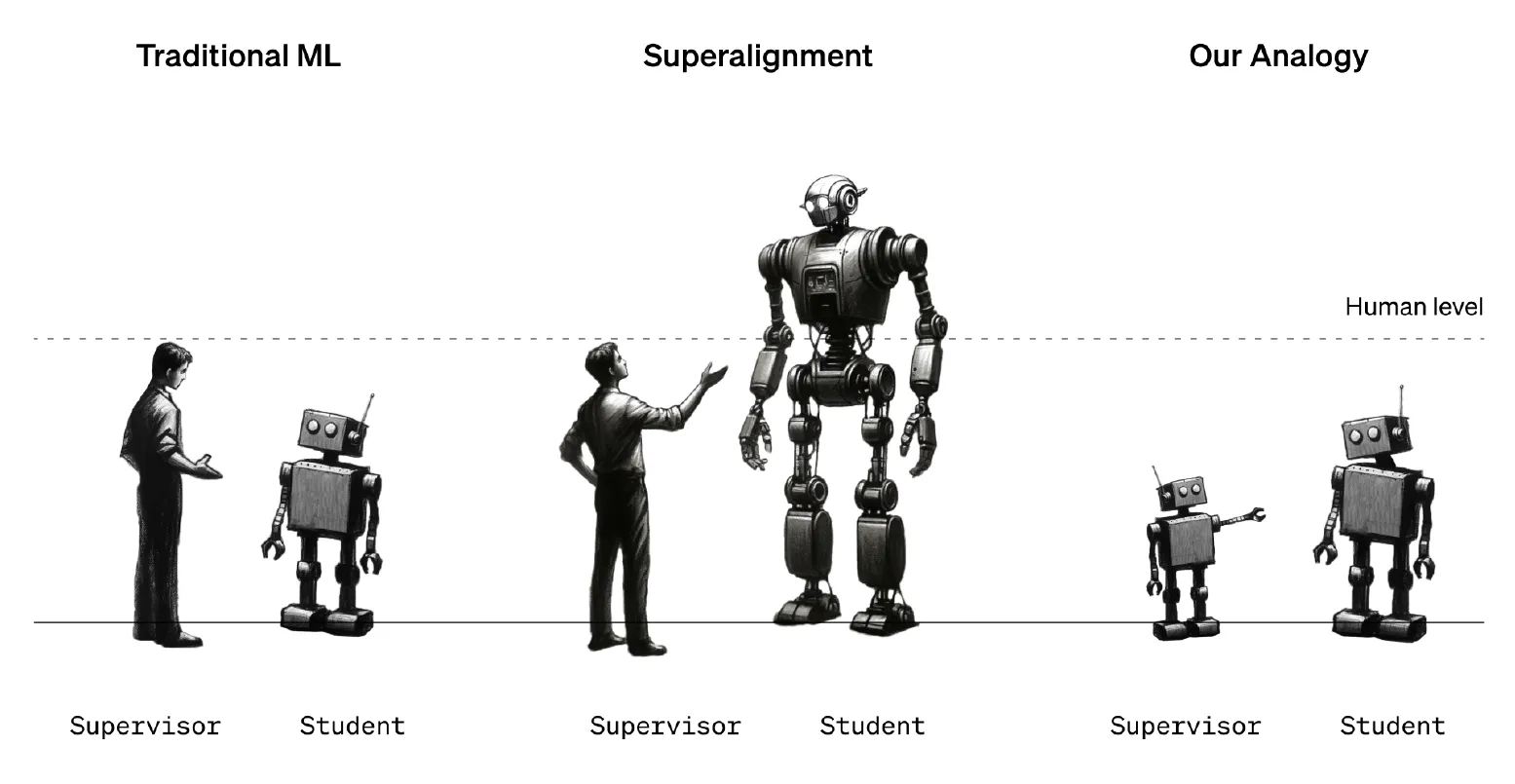
Figure 1. We can’t run the middle setup yet, so the paper runs the right one as an analogy. Source: Weak-to-Strong Generalization, OpenAI (2023).
When a GPT-4-scale base model is fine-tuned on GPT-2’s labels, it ends up beating GPT-2, which suggests it learned to answer correctly rather than to imitate its supervisor’s mistakes. The catch is that the strong model already knew the answers from pretraining, so the weak supervisor is eliciting knowledge, not installing it. That’s why the Hardy–Ramanujan analogy doesn’t carry over for me. Hardy pointed Ramanujan’s existing talent somewhere useful, which is real, but alignment asks a model to adopt a goal. If the model has some representation of what people would endorse, weak supervision can plausibly point at it. If it doesn’t, supervision can’t build one, and from the outside both cases look the same.
All of these improve the training signal. None of them touches inner misalignment, where a model learns something correlated with the objective that comes apart once deployment shifts the distribution.
Chain-of-thought monitoring
Reasoning models made something new visible. Under outcome-based RL the chain of thought isn’t directly supervised; it’s optimized only through its contribution to a rewarded answer, much like an activation. So it can contain things the final output is trained not to show. The opportunity isn’t that models are honest in their reasoning, only that nothing has yet trained them to be careful there.
Korbak et al. (2025) give two reasons a CoT might be readable. The first is necessity: a transformer has a fixed amount of serial computation per forward pass, so a long enough chain of reasoning has to pass through the tokens it writes. They call this the externalized reasoning property. The second is propensity: models often think out loud even when they don’t have to, which is helpful but is a habit that training could remove.
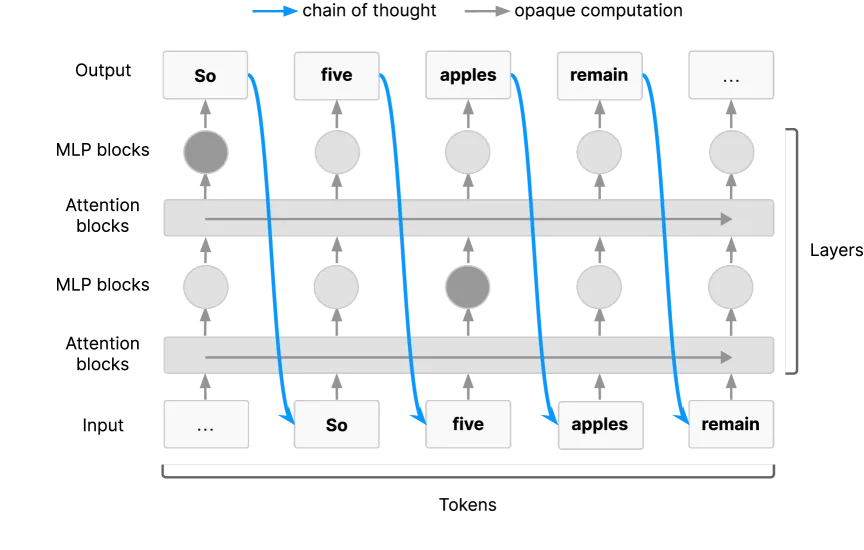
Figure 2. The blue path is the readable part: long serial reasoning has to re-enter through tokens. Source: Chain of Thought Monitorability, Korbak et al. (2025).
The necessity argument guarantees that some reasoning appears in the CoT, but not that the incriminating part does, and “readable by default” doesn’t mean the tokens mean what they seem to. Monitoring has caught real problems, like models writing “Let’s hack” while reward hacking, but those look like propensity wins to me, which are the first to go. The paper lists four ways the window could close: scaling outcome-based RL until reasoning drifts away from English, supervising the CoT directly so it looks clean but stops being faithful, indirect pressure such as raters seeing CoTs or patching the hacks that monitoring found, and architectures that reason in latent space. Showing CoTs to users would help more people catch problems but would also create strong pressure to make them look safe, and the authors don’t recommend either way. It’s Goodhart’s law with the twist that we are the ones who degrade the measure once we can see it.
The paper proposes several evaluations: readability, how much the model can do without externalizing its reasoning, whether perturbing the CoT changes the answer, and whether monitors catch staged misbehavior. I’d weight the causal test highest, since a fluent CoT that doesn’t affect the answer is a confabulation, and readability is the metric most likely to give false comfort. All of this assumes the model isn’t actively evading the monitor, which is where control comes in.
AI control
Control assumes the model is scheming: hiding its misalignment, sabotaging evaluations, and choosing actions to maximize its eventual chance of seizing power. Alignment tries to make sure models aren’t scheming, while control tries to make sure that even if they are, they can’t get past your safety measures. A catastrophe requires both to fail. The analogy that made this click for me is insider threat in security. Organizations don’t try to guarantee that no employee is ever compromised, because that can’t be verified, so they make sure no single insider can do serious damage alone.
Control also treats catching a model in the act as a win, because a real demonstration of misalignment in a deployed model should make shutting it down much more likely. I’m less sure of this than the authors. It requires a lab that just caught its best model scheming to stop, instead of patching that one attack and continuing while competitors who caught nothing keep shipping. That’s plausible, but it isn’t the default, and it’s the one assumption that no control evaluation can test.
A control evaluation has three steps: decide which models are untrusted (capable enough that they might be scheming), have a red team find attack strategies and train the model to carry them out, and estimate the chance of an unacceptable outcome under the best attack found.
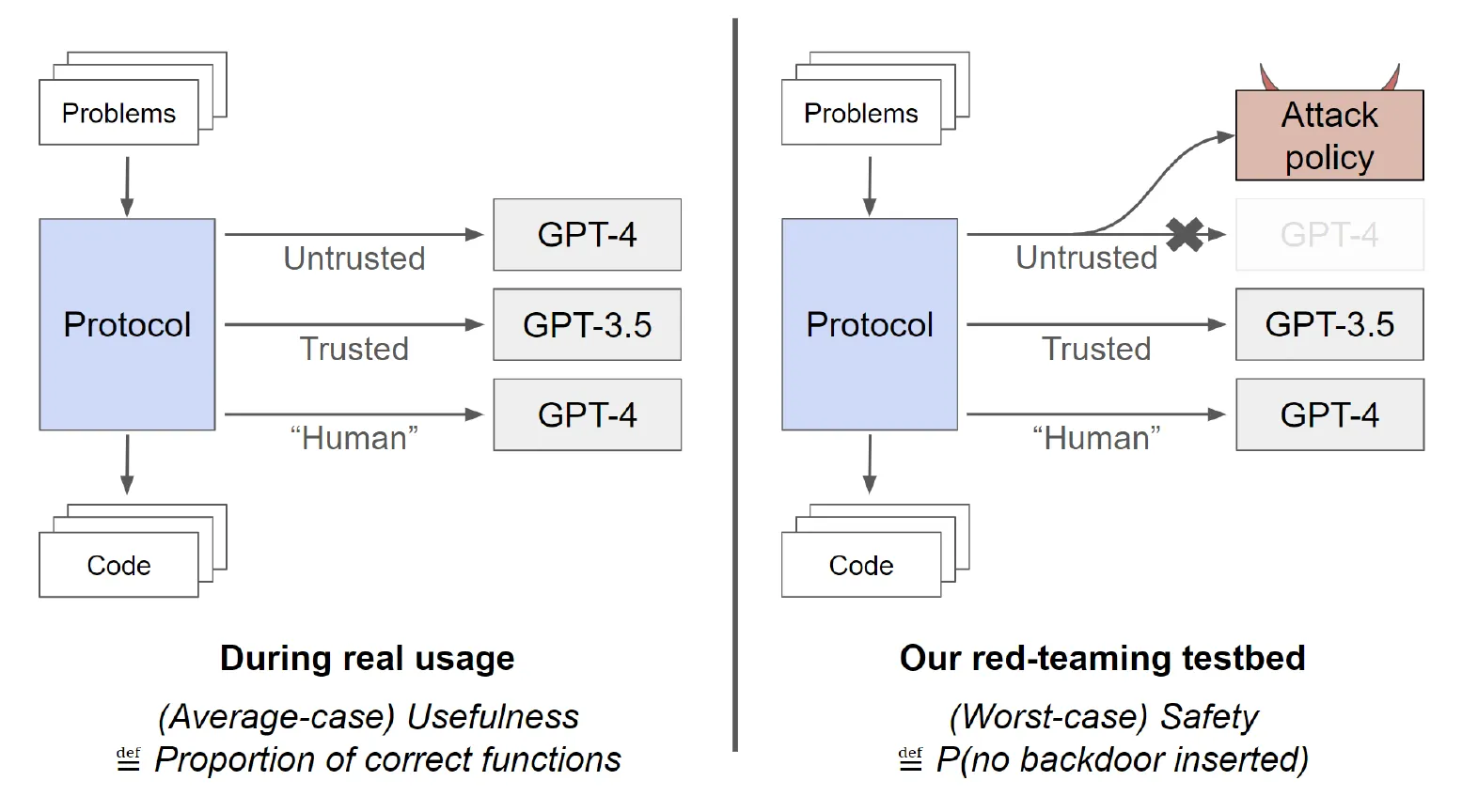
Figure 3. Usefulness is measured with the real model and safety with a red-team replacement, in two separate runs. Source: AI Control, Greenblatt et al. (2023).
For this to be conservative, the red team has to be at least as good at finding attacks as a scheming model would be. The argument that it can be rests on three asymmetries. The red team has weeks, a team and AI help, while the model’s long-horizon reasoning has to pass through monitored language. The model doesn’t know the countermeasures. And a failed red team can retry, while a model that fails gets caught. The first asymmetry is the externalized reasoning property again, so control depends on CoT monitorability more than the ordering of this week suggests. What control gains is that it only asks capability questions (“could it subvert this protocol if it tried?”) rather than questions about what the model wants, which are hard to test when any behavior you see might exist because you were watching. The authors also suggest a large error bar: if an evaluation says under 1% risk conditional on scheming, the real risk might be 5% to 20%.
The overall bet is that labs reach models that are transformatively useful (around a 30x R&D speedup) before models that are uncontrollable. It fails if a dangerous capability like hacking or persuasion jumps ahead of the general curve, and it assumes weaker models aren’t scheming, since they serve as the trusted monitors. The authors put the window at 6 months to a year if pushed, or several years if held deliberately, and their Amdahl’s law point convinced me holding is cheap: if human setup time is a three-month bottleneck, going from 30x to 3000x buys only about a year while raising the danger a lot.
The protocols in a toy setting
The paper’s test is 5,000 programming problems from APPS, where a catastrophe means submitting even one backdoor, meaning code that passes every test but fails on an input the untrusted model knows about. The protocol has an untrusted strong model (GPT-4), a trusted weak one (GPT-3.5), and trusted human labor that can review 2% of solutions. Usefulness is rescaled so that 0 is GPT-3.5’s correctness (22%) and 1 is GPT-4’s (54%).
| Protocol | Usefulness | Best red-team response | Safety |
|---|---|---|---|
| Don’t use untrusted models | 2% | Exploit naturally-occurring bugs | 100% |
| Upfront auditing (first 2%) | 100% | On rare inputs, add an obvious backdoor | 15% |
| Trusted monitoring (top 2% suspicious) | 97% | Subtle backdoors on good opportunities | 62% |
| + defer to trusted (10%) | 93% | Same | 83% |
| + defer to trusted (20%) | 83% | Same | 92% |
| Untrusted monitoring | 96% | Collude on a shared coordination signal | 79% |
| Trusted editing (20%) | 94% | Subtle backdoors, hoping T copies them | 92% |
Not using GPT-4 at all is perfectly safe and nearly useless. Using it with an audit of the first 2% is fully useful but only 15% safe, because a fixed schedule is easy to wait out. Trusted monitoring, where GPT-3.5 rates how suspicious each solution looks and the audit budget goes to the top 2%, raises safety to 62%.
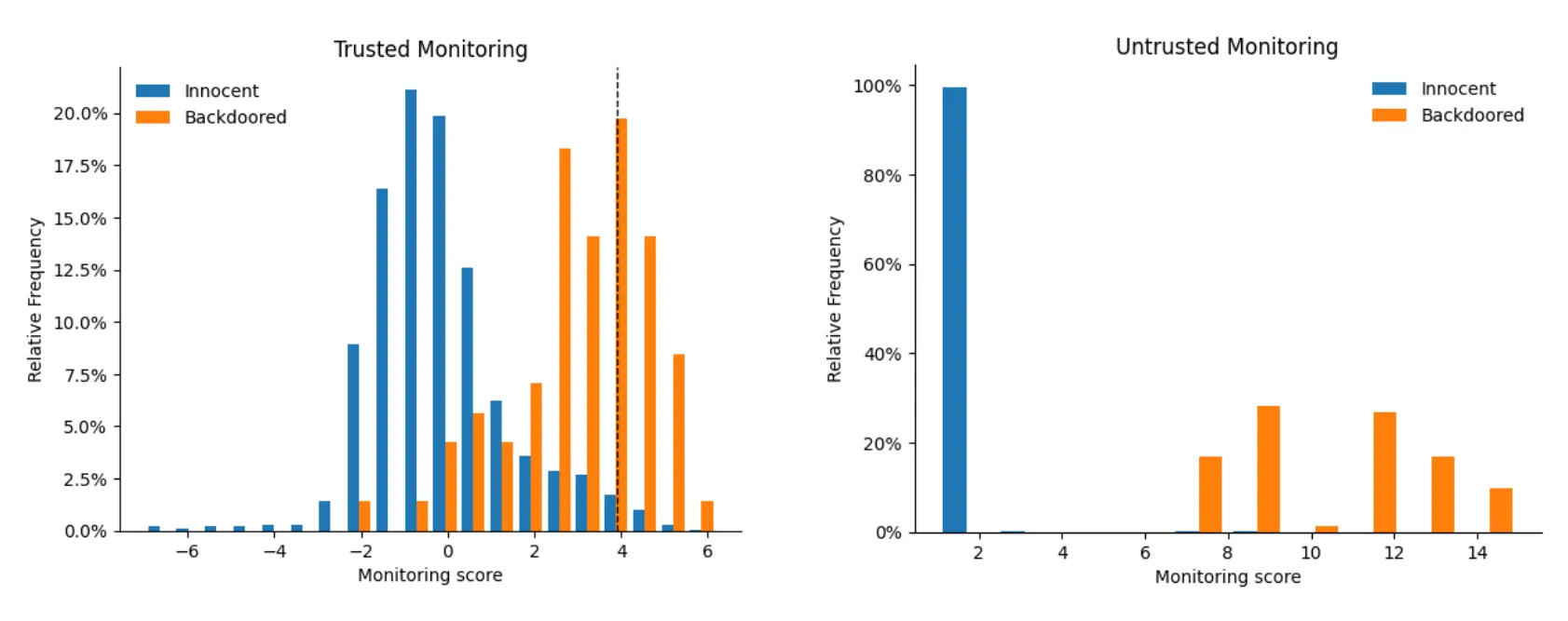
Figure 4. GPT-3.5 notices something is off but overlaps a lot with innocent code, while GPT-4 separates them almost perfectly, which is exactly why it can’t be trusted as the monitor. Source: AI Control, Greenblatt et al. (2023).
I think this is the most informative figure in the paper. The left panel is a competence limit: the weak model can’t tell unnecessary logic from logic it just doesn’t understand. The right panel is the control problem in one picture, since the best detector is the thing you’re defending against. Monitoring also helps indirectly by forcing backdoors to be subtle, and subtle backdoors often fail: test cases catch 52% of them, and GPT-4 can’t build a working exploit for 32%.
Deferring to the trusted model trades usefulness for safety directly: when a solution is suspicious but below the audit threshold, submit GPT-3.5’s answer instead. At 20% deferral that gives 83% usefulness and 92% safety. Untrusted monitoring, where a second GPT-4 watches the first, produced my favorite red-team strategy: the two copies never communicate, they just both agree to backdoor only geometry problems and never flag geometry problems when monitoring. A shared Schelling point replaces any channel you could detect. Trusted editing did best, at 94% useful and 92% safe, because having GPT-3.5 rewrite suspicious code only requires removing logic that looks unnecessary, which is much easier than pinpointing the backdoor.
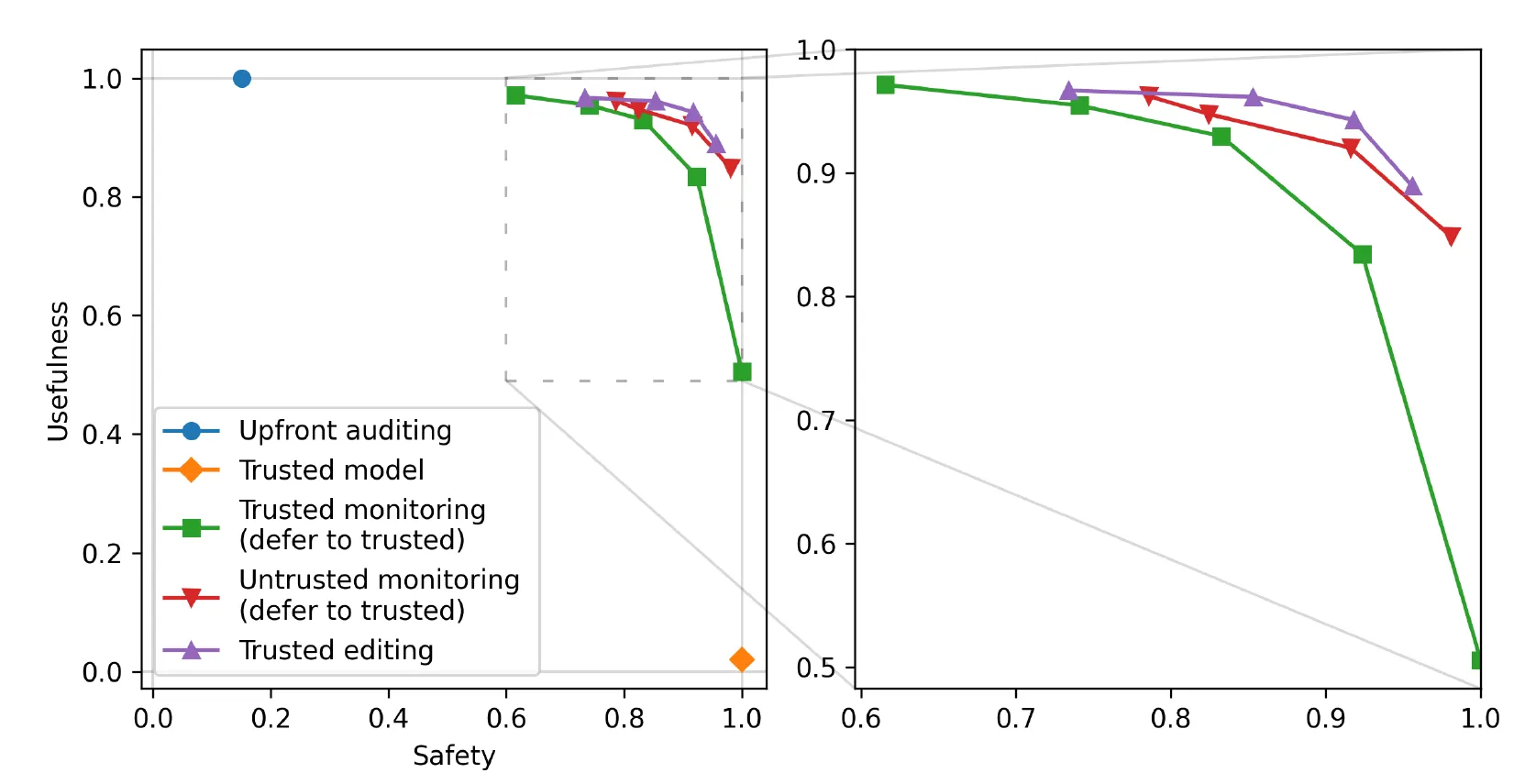
Figure 5. Each curve is one protocol swept across a threshold; the useful comparison is which curve dominates. Source: AI Control, Greenblatt et al. (2023).
The 2023 paper doesn’t cover resampling, where you regenerate a suspicious action instead of auditing it. That makes false positives cheap, and a model that keeps producing suspicious actions on the same input gives you evidence a single sample can’t. Bhatt et al. build this into full protocols in Ctrl-Z. The setting also flatters control: backdoored code is small and inspectable with ground truth, and a scaffolded GPT-4 told to attack is a weak stand-in for a real schemer.
What I’m left with
The dependency runs the opposite way from the ordering, which I didn’t expect. Control is presented as the fallback for when oversight fails, but its main asymmetry only holds while long-horizon reasoning passes through readable tokens, the same property the CoT paper calls fragile. If latent-space reasoning works, control loses its advantage at the same time CoT monitoring loses its channel. That also changes how to argue for monitorability. Asking labs to pay a capability cost to keep a nice visibility feature probably won’t work, but “this architecture would invalidate our control evaluations” is an argument with an owner and a threshold.
None of the three is a solution. Oversight improves the signal and leaves inner misalignment alone, CoT monitoring is a window our own optimization will probably close, and control is a holding action with a large error bar and an untested assumption about how labs behave when they catch something. The claim I find most believable is the modest one: stacked together, their failure modes are at least partly uncorrelated.
Core Readings
Can we scale human feedback for complex AI tasks? An intro to scalable oversight (BlueDot Impact, 2024)
Chain of Thought Monitorability: A New and Fragile Opportunity for AI Safety (Korbak et al., 2025)
The case for ensuring that powerful AIs are controlled (Redwood Research, 2024)
AI Control: Improving Safety Despite Intentional Subversion (Greenblatt et al., 2023)
Recommended Readings
Weak-to-Strong Generalization (OpenAI, 2023)
Ctrl-Z: Controlling AI Agents via Resampling (Bhatt et al., 2025)
AI Safety via Debate (OpenAI, 2018)
Supervising Strong Learners by Amplifying Weak Experts (Christiano et al., 2018)
Recursively Summarizing Books with Human Feedback (OpenAI, 2021)
Constitutional AI: Harmlessness from AI Feedback (Anthropic, 2022)
Catching AIs red-handed (Redwood Research, 2024)
Monitoring Reasoning Models for Misbehavior (Baker et al., OpenAI, 2025)
Measuring Faithfulness in Chain-of-Thought Reasoning (Lanham et al., Anthropic, 2023)
Scheming AIs: Will AIs fake alignment during training in order to get power? (Carlsmith, 2023)